
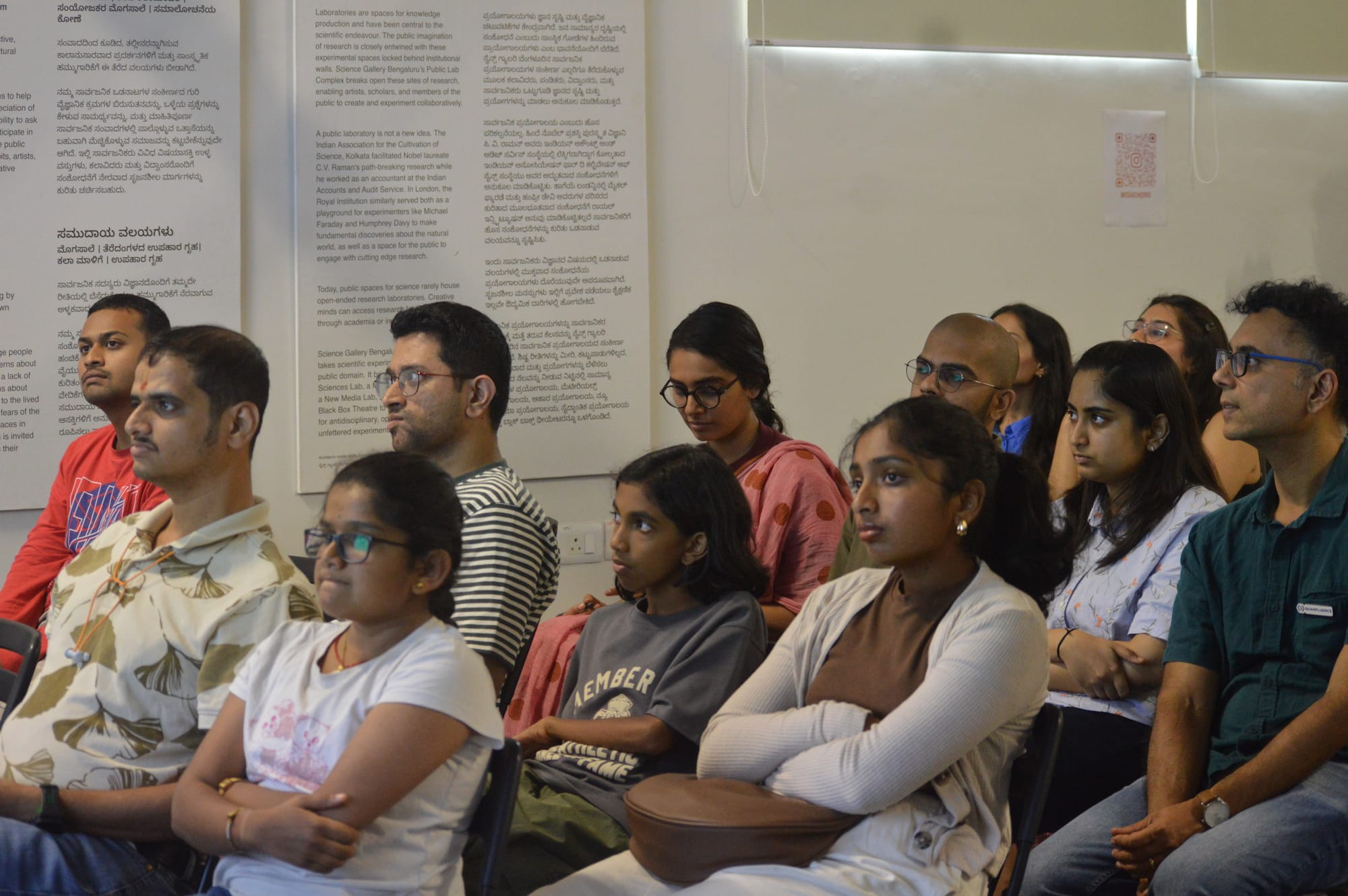
Written by Muskaan Chhabrani
The following discussion begins with questions and unfolds eventually into answers some complete and some incomplete. The definition of the terms may not be completely true but are presented as how the participants in the unconference at that moment think, understand and know them.
Sentience, by definition, is the capacity to feel. But, how do we really understand this capacity to feel? What do we understand about all the creatures who are capable of feeling? We first went around dissecting this term which brought up lots of nuances which we rarely consider in our day-to-day lives.
Sentience means that I am aware, aware of what is happening with me. It means to be conscious of one's feelings. At its root we can say, one feels pain (being aware of what one wants to avoid) and pleasure (being aware of what one desires). So, sentient beings are all those living beings who have a sense of pain, suffering and pleasure.
In a broader sense, the meaning of sentience can be easily confused with consciousness in humans which led to a further discussion on, ‘Are animals really conscious?’ One argued that they are not as conscious as humans. Here is where understanding the distinction between consciousness and sentience becomes very important. One can say that there are different dimensions of being conscious which vary from one species to another, but the existence of sentience in living beings is the one which matters. Sentience makes all beings matter. They matter, in a sense that they have some choice of seeing what happens to their body, that is how to protect it is in a way, their decision.
A natural question, or for starters, a statement which comes up very frequently in such discussions found its way in the unconference as well: Plants also ‘react/respond’ to certain stimuli. This was a very good point to be raised. This made us really think about the difference between a plant responding and an animal responding.
One can get a sense of this difference with a simple thought experiment. Imagine a tree and a goat and imagine approaching first the tree with an axe and then the goat. Which one is likely to run away or get scared by the axe?
In this, one participant argues that we as humans with our understanding interpret a particular response and emotion expressed by the animal as fear as that is how we understand fear for us humans, how do we exactly know that it is indeed fear in the animal. To polish the question a bit, ‘Is the behaviour and emotions expressed by animals as we understand them the correct interpretation?’ For the layman - what we are aware of, what happens within us or with us, we do have the ability to recognise that in others as well. We did not need any elaborate lab experiments to verify that my fellow human being is suffering. A cry is a cry, the fact that we choose to ignore it or not acknowledge it is a different concern. Experimentally also, it is now well-established that animals have specialized nerve cells and brains to integrate sensory data into a unified mental state and also have specialized nociceptors which transmit signals that the brain translates into the conscious experience of suffering while plants lack the anatomical structures required to generate a centralized stream of consciousness.
Another question which arises here is of ignorance. We are conscious enough to realise our pain but at the same time ignorant enough to acknowledge what has been established. Are our choices based on these facts? No, there is a lot more comfort and convenience involved as one honest participant pointed out. Coming back to the question of sentience, a wise old man in our group recalled with a sweet smile on his face, his experience with his companion dog. The feeling of being able to relate with each other so closely, gave him a sense of empathy for his world and he supposes the same was felt on the other side as well!
The first part of our sentience discussion sparked further questions to ponder upon and left us with several points to consider as we moved on to discuss why among all animals - we have a few whose feelings have been overlooked to an extent that every part of their body is a business product for trade.
Yes, the unsung beings in agriculture as I like to call them, sacrificing their lives to the noble cause of feeding the humans of this planet, providing nutrition and luxury as some of us humans like to believe is what these innocent ones are here for.
Although science is considered to be an objective domain - the questions one chooses to answer are a lot more biased than we take notice of. Have we wondered enough to really understand how a hen, cow, buffalo, goat, pig or a fish’s, to name a few for the Indian context (there are more) world looks like? There has been limited research about their characteristics, their qualities but more on how to extract milk, eggs, flesh - nutritional value from their body. Whenever we do a google search - on studies about cows, hens, pigs, goats - the result is quite saddening but informative for the economy driven society.
This necessitates a critical inquiry into: What kind of world are we moving towards when food science is only about extracting the best possible source of nutrition with partial knowledge of who the source is?
Isn’t it time we reformed our approach to seek and discover solutions that not only recognises but also acknowledges the unique worlds of the sentient beings with whom we are obliged to share this planet? Shouldn’t this also be a part of a sustainable world we wish to live in?
One participant reflected and observed the disconnect that although we are a part of these discussions at places we choose to be, everyday lives just don't seem to reflect the same values in our actions. We are unfair to our fellow humans that considering animals is a far fetched ideal. We all wryly agreed but on a serious note, saying that we have this attitude is honest. But, comparing this with the mass assault and killing of animals in the animal agriculture industry is quite dishonest and apathetic which must be noted. We are talking about the extreme conditions here. Yes, there exist people who disregard other people - but there exists a legal framework for the people, to protect their rights and their bodily autonomy. Do we really have a well-thought, well-planned system to protect all the species including these farmed animals?
After some thought, there comes a question: Are we talking from a moral
perspective? We, as humans, are trying to think from their perspective but is there
such moral consideration amongst the animals we are discussing? Do animals
have such moral consideration? If yes, which ones and what exactly does morality mean in their kingdom? That’s a dimension that must be probed further but first let’s come back to the centre of where we started and pose this question back to ourselves - we do have some understanding of morality, so why don’t we take the responsibility and be curious of their perspective.
The last point was raised by a very hesitant participant who remarked that farming involves killing many soil animals, to which we questioned further that is it a systematic, well-organised practice as the dairy, poultry, meat industry ? How to avoid that, what are the other methods one can switch to, to put a stop to this is another dimension one can research!
All these questions arise from a willingness to wonder and work towards a shared world in which all sentient beings and perhaps all living beings are acknowledged and valued! Our comfort doesn’t let us change - there are so many movements we want to be a part of, but the one which can start with our own plate, though closest to us, maybe is the hardest to confront.