
What happens when you create a scaffold (Sci-fold?) for science and art to not just meet, but actually get folded in together?
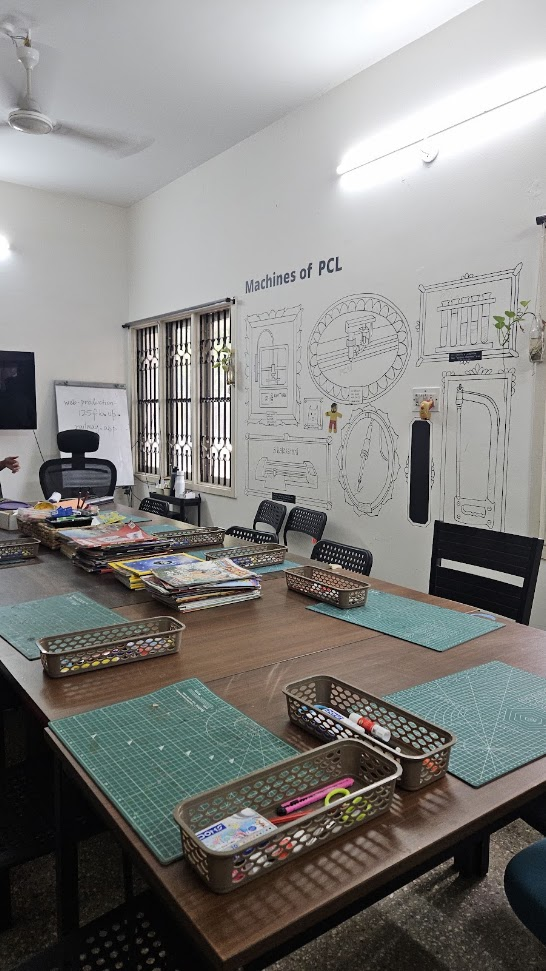
That’s exactly what we did on a quiet Saturday morning in Indiranagar when we got together for a zine-making workshop. Sci-fold was our pilot Offshoot event for MOSAIC’s Science Sante, held at Paper Crane Lab on June 13, 2026, and facilitated by Kadambari Patil.
MOSAIC — or Movement for Science Appreciation through Inclusion of Communities — is an experimental effort that brings together various stakeholders in science and society to learn, interact and grow together.
While Science Santes are quarterly flagship gatherings, Offshoots like Sci-fold are smaller, satellite experiments that happen in between Santes. And this one had an interesting twist: we paired scientific researchers with science communicators and artists to co-create and translate complex ideas into a more tangible and artistic format: a Zine.
What exactly is a zine and what makes them special?
A zine (derived from the word ‘magazine’) is a tiny, handmade, and self-published booklet. It’s usually just a few sheets of paper folded, stapled, or taped together and can be made by anyone, and be about anything: a feeling, a protest, an idea, a family recipe, a memory, a question, or just something that you’re trying to work through.
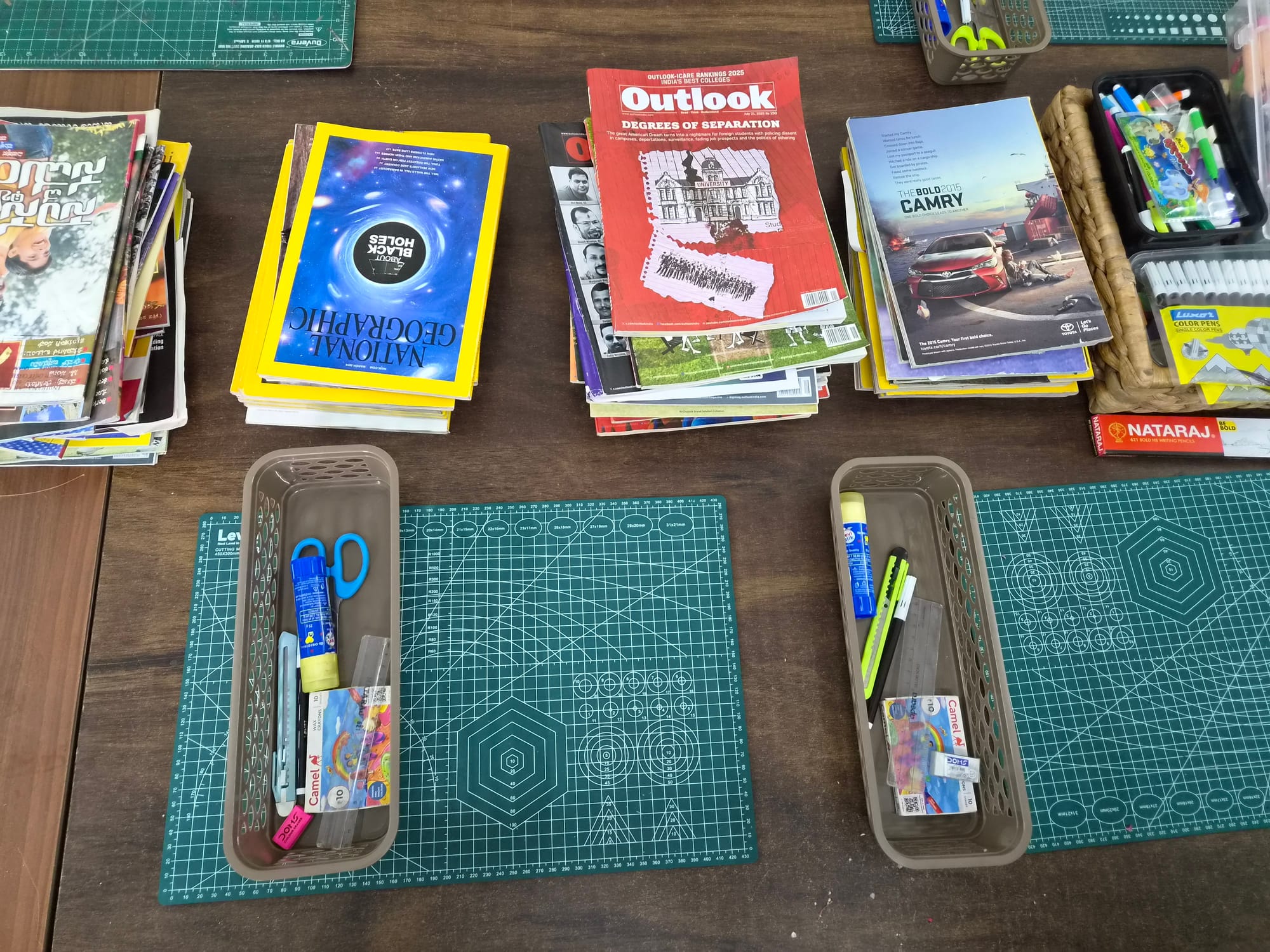
There are usually no formatting or design guidelines, no editor to impress, no fancy design software or artistic skills to master, and no "right" way to make a zine — just scissors, pen, paper, glue, and an idea to express (well, maybe also some images cut out from vivid magazines to scrapbook your way through it, if you don’t prefer draw and illustrating)!
What makes zines truly special is not one but a ‘mosaic’ of reasons: they are really easy to create; they defy conventional rules and genres; they are a medium accessible to anyone; and most importantly, they are an act of rebellion in themselves! Zines emerged from punk, queer and DIY self-publishing cultures as a bid to counter the gatekeeping of academic and capitalistic structures, making them a truly open-source format and a democratic medium for sharing ideas!
Zines also force you to slow down and turn your visceral emotions and evolving thoughts into something tangible that you can hold and process further. In a world of instant, processed and AI-generated content, a zine is refreshingly unfinished, personal, and a rebellious reminder that our ideas are worth sharing, exactly as they are!
There's also something special that the folding and cutting of paper does to your thinking that writing alone doesn't. You're also forced to visualise complex ideas into simpler graphical forms, and compress and prioritise information — choosing a single image, phrase, or metaphor per tiny page — that really slows you down in a good way. This friction and tension of this deliberate decision-making are integral aspects of human creativity. And that is exactly what we chose to delve into as part of the zine we made during this workshop.
How did I get involved in Sci-fold?
Although I missed the first Science Sante earlier this year (given I was not in Bengaluru then), I did hear about it from lots of people I knew, and made sure I made my way to the second Sante that happened at VITM. Finding an initiative that was so close to my own values and motivations in life — bringing together science and society in inclusive, accessible and FUN ways — I greatly enjoyed the event and networked with loads of interesting folks from all kinds of contexts and backgrounds. Towards the end of this event, I naturally offered to volunteer to help organise future events, and this is how I found myself on a Zoom call with MOSAIC volunteers involved in planning future MOSAIC events. And before we knew it, we were well on our way to organising our first Offshoots event: Sci-fold.
A slight detour to catch-up: Reflections on Science Sante BLR #2
Most of the work of organising and executing this workshop was done by Kadambari as the facilitator; Mathura, Aditi and the PCL team as the event venue hosts; Kaustubh, Roshni, Vishnu, Sneha and others from the Samagata Foundation taking care of the website, registrations and publicity; and I only had a really small part to play in terms of event design and outreach. Naturally, I came into the event thinking I’d be a neutral observer, help Kadambari out with anything she needed, and help out with event logistics, if needed. But little did I know that I would end up being an active (and enthralled) participant in the workshop itself :)
Pairing Researchers and Communicators
The core idea behind pairing scientific researchers with science communicators or artists for the workshop was to explore new ways of engaging with and expressing science. We felt that combining a researcher's subject expertise with a communicator's storytelling skills could lead to creative and engaging portrayals of scientific ideas. With MOSAIC being an experiment in itself, we wanted to approach this pairing as an experiment as well.
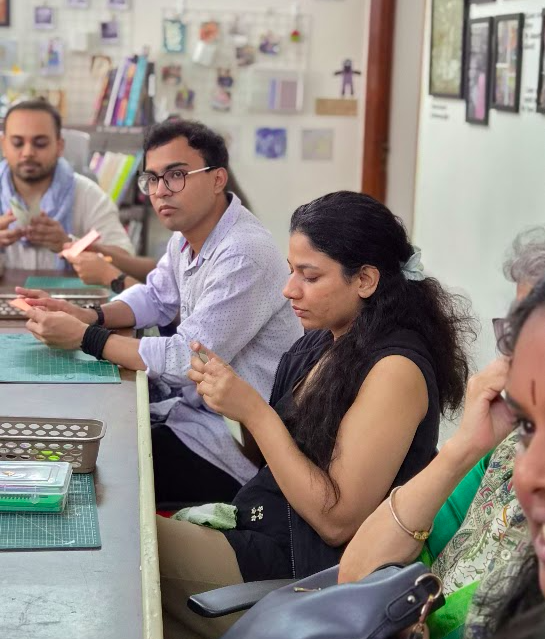
To encourage fresh interactions, we didn't invite participants solely from the existing MOSAIC community. Instead, we reached out to scientists and scientific organisations within the MOSAIC network to nominate researchers for the workshop, while science communicators were invited through our personal networks. As a result, around 85% of the participants were new to MOSAIC and had not attended any of our previous events.
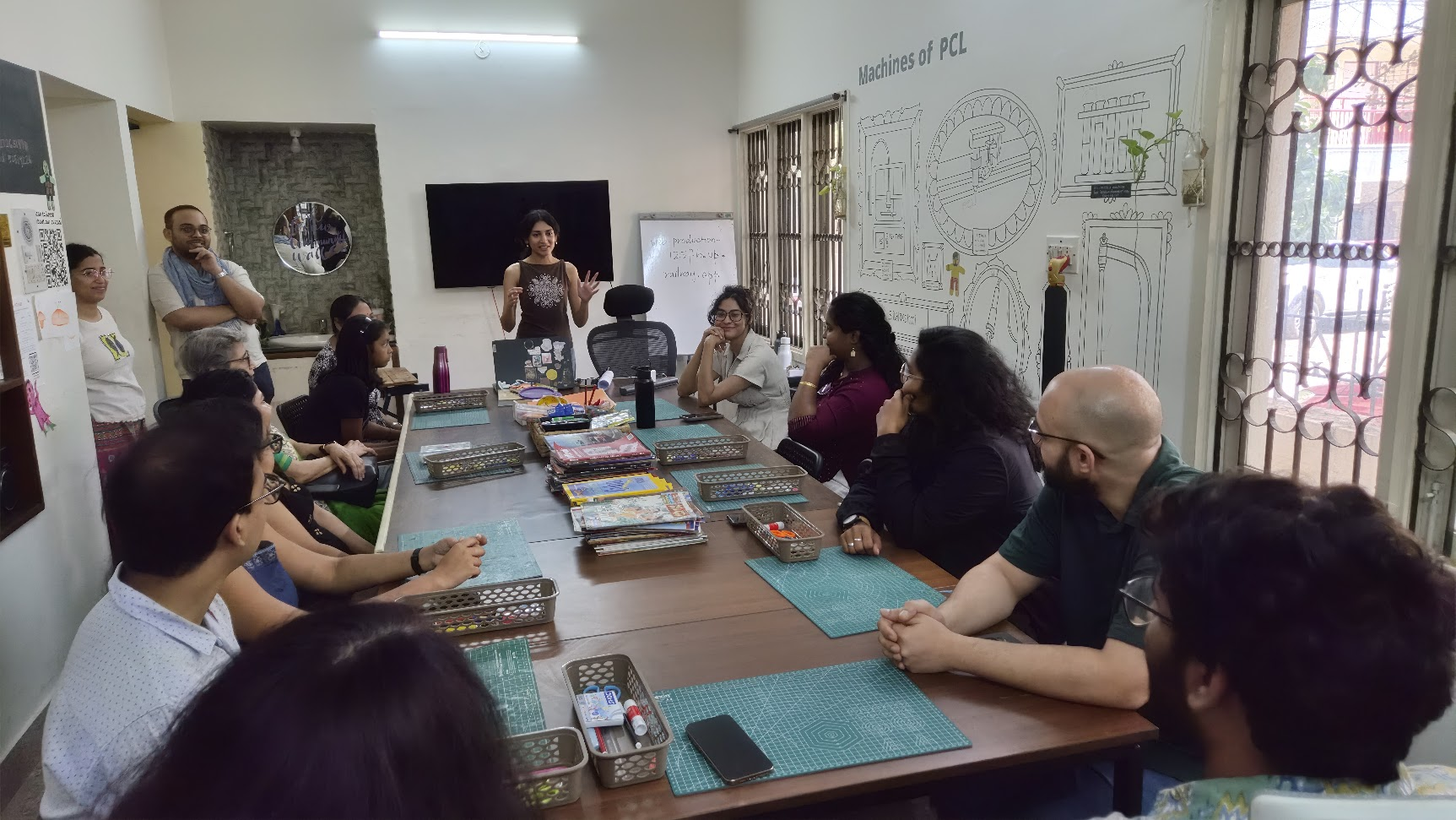
After a round of introductions, almost everyone found a partner whose technical expertise and artistic skills complemented their own, allowing them to pair up for the workshop. One participant, however, was left without a partner, and I was (to my surprise!) asked to step in to fill this void.
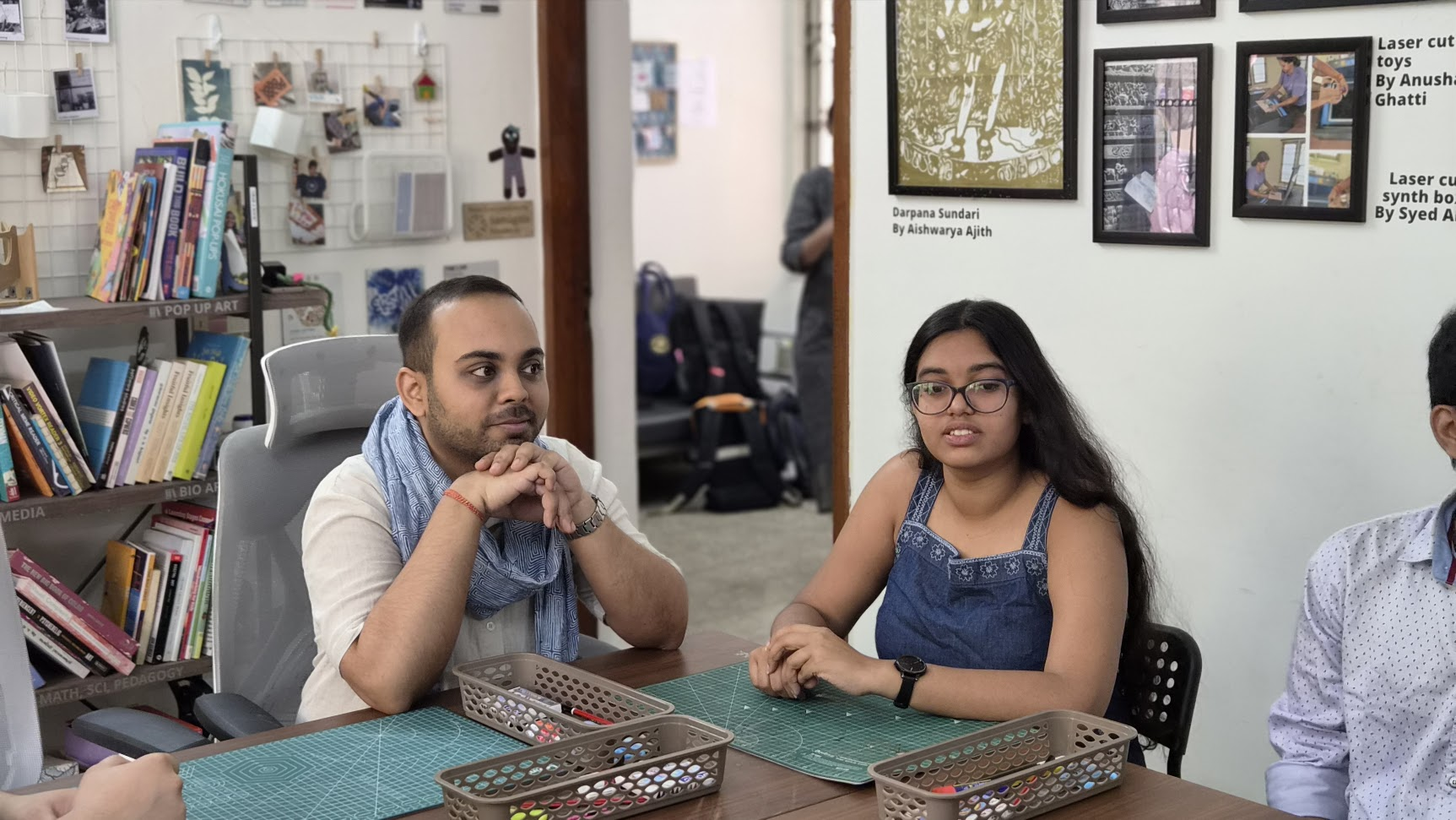
I was soon paired with Dhanya, a budding researcher in astrophysics (a summer intern working at IIA Bengaluru for the next few weeks). Naturally, I expected that I’d be asked to be the communicator half of this pairing. But to my surprise, Dhanya expressed an interest in being the artist/communicator for the day, and asked if I could be the researcher instead.
So, I happily obliged and put on my (science communication) researcher hat for the first time in the context of such a public workshop (where I’m usually the workshop facilitator or at the very least the science communicator). I agreed to bring to the table a critical idea that I've been working with for a while, as something we could make a zine about: the impact of genAI on research and education today.
While we were still brainstorming and discussing our zine topic, I soon noticed Gunja aunty — who had come along that morning simply to accompany her daughter (and my dear friend), Sanjna Banerjee — sitting quietly in a corner. I approached her and invited her to join our group, but she was hesitant and assured us that she was very happy observing the workshop from a distance. I had learnt just a few minutes ago that she had been a history professor for over 30 years, and insisted that she join our group to help us, if not simply to participate. I genuinely believed that her decades of teaching experience would be extremely valuable for us to reflect on how AI was reshaping education. But I was also persistent about including her, because to me, zine-making is truly meant to be for everyone, regardless of age, discipline, or context. And, to our delight, she agreed :)
Building the zine together
As Gunja aunty now joined our team, we landed on a question that all three of us, from our different vantage points, kept circling back to: Free Will in the Age of AI — Do we really have a choice?
We wholeheartedly began debating and discussing how AI was quickly changing the landscape of education and research, and how the fear of competition, speed, efficiency, and fast results in the age of AI were suppressing several aspects of human ingenuity, creativity, curiosity, and interdisciplinarity. We eventually came to the conclusion that while we can’t completely stop the rise of genAI in society, we do have a choice to using it more slowly, ethically, responsibly, and under suitable guardrails, to ensure that these deeply human aspects are not entirely compromised in the process.
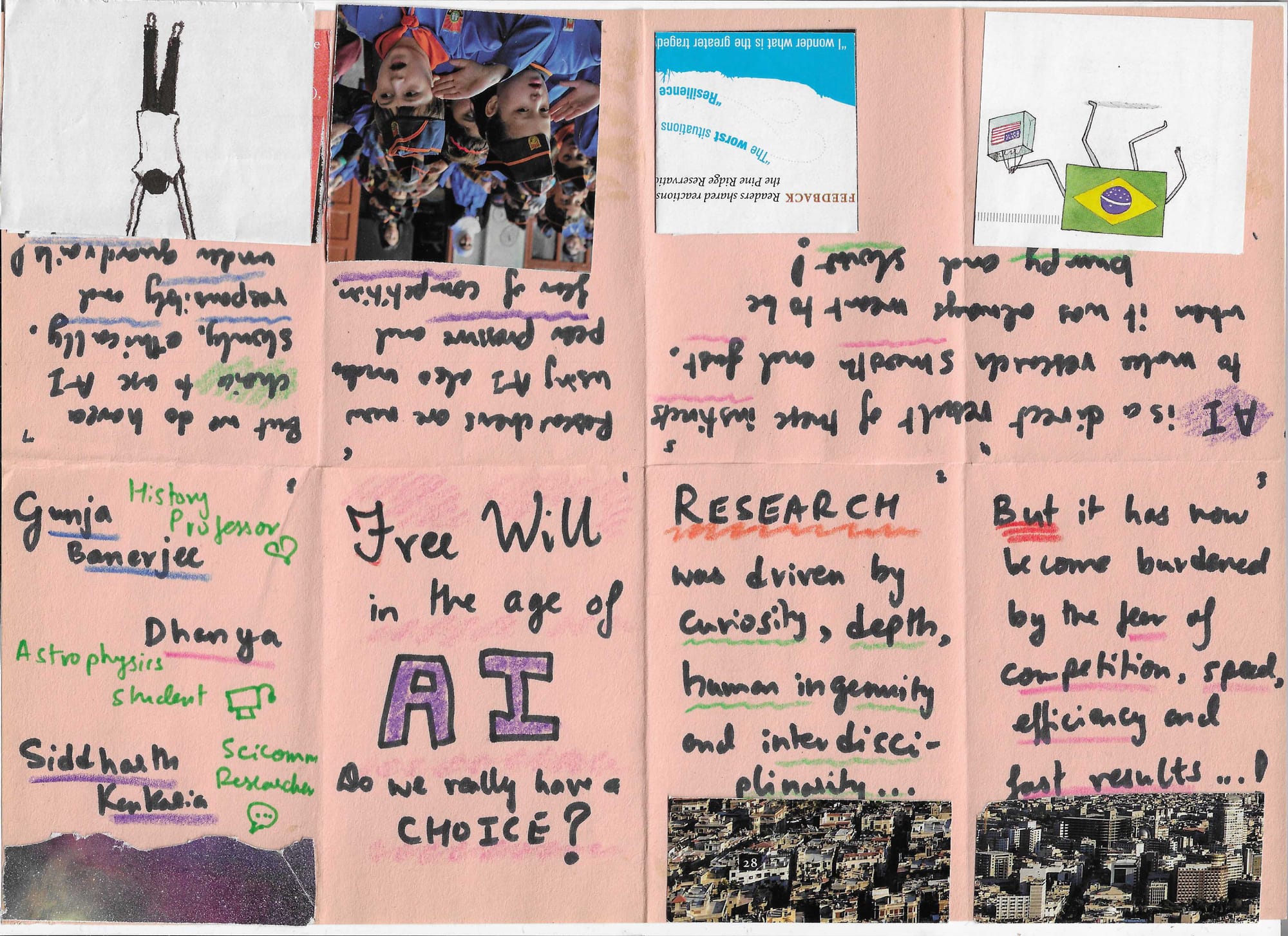
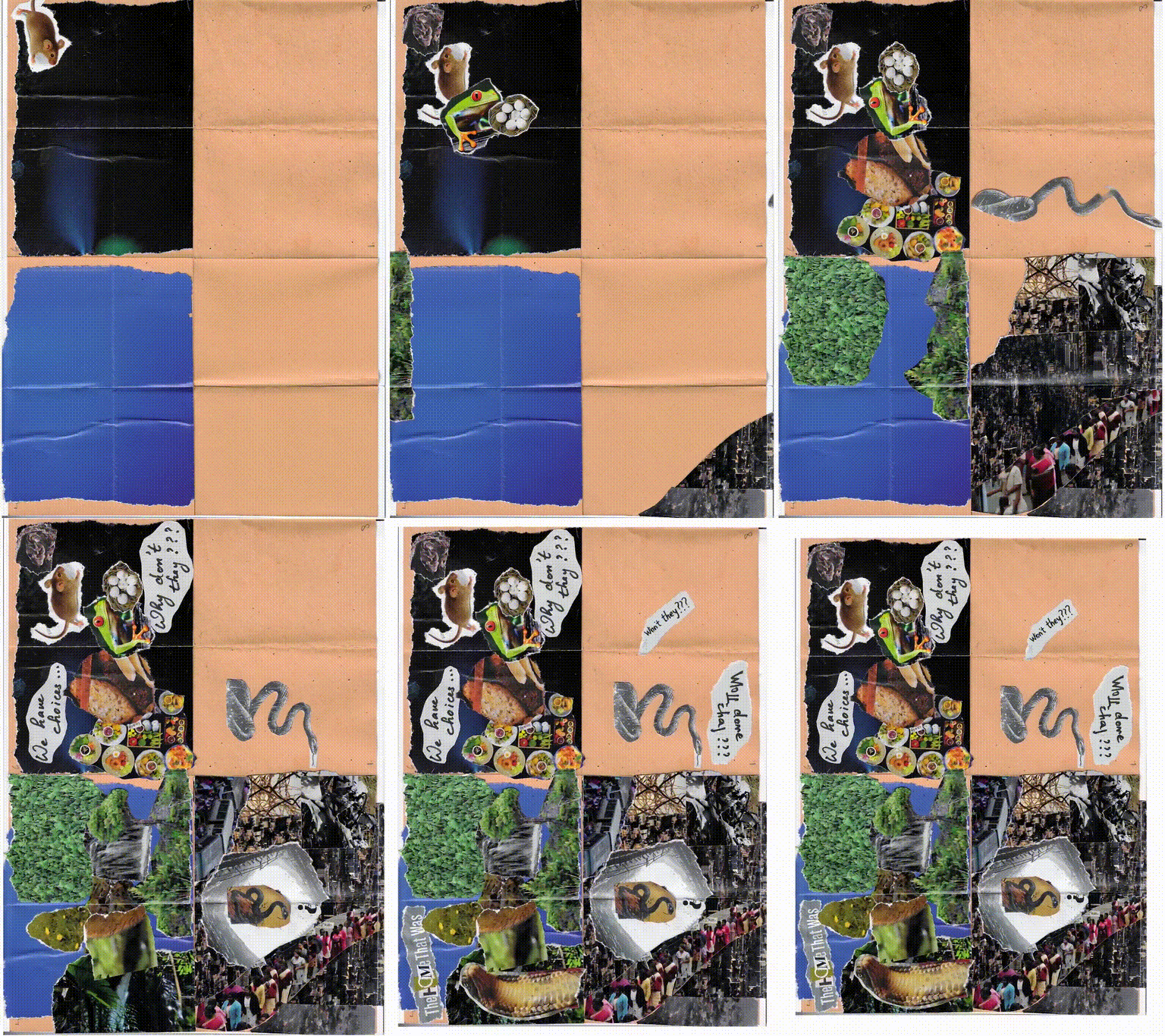
I’ll let you read the zine (above) for yourself to know more, but we had a lot of fun conceptualising and making this zine, and finding the perfect magazine cutouts to include in our zine instead of drawing everything by hand. The zines created by other participants were equally fascinating and full of creativity and wonder: ranging from aspects like ‘Chemistry in Supercomputing’, ‘Break The Cycle - A Zine on Dengue Prevention’, ‘Neuromorphic Materials’ to name just a handful.

Why such events matter?
Irrespective of how useful or valid our zine was as an output in itself, I felt that the process of co-creating it together was far more valuable for all of us. And to be honest, a history professor, an astrophysics student, and a science communicator working in tandem to debate, discuss and translate a shared idea onto a single sheet of folded paper was, in itself, a small demonstration of what MOSAIC stands for and is trying to achieve: making knowledge participatory, inclusive, and joyful!
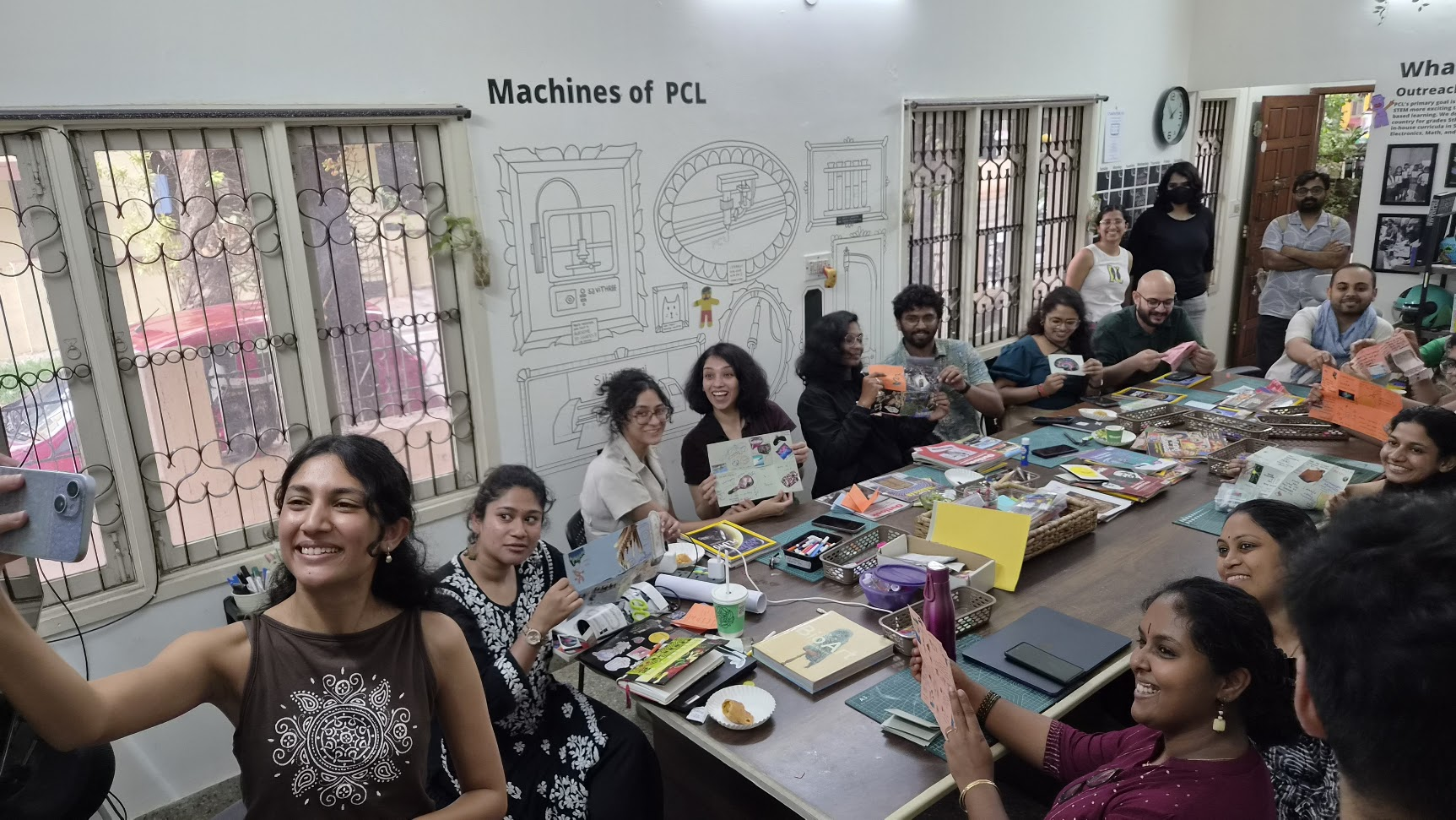
If this kind of hands-on, cross-disciplinary conversation around knowledge-making and -sharing sounds like your jam, our next Science Sante is coming up soon this August — so do keep an eye out for more details soon, and come prepared to immerse yourself in a mosaic of ideas, provocations and reflections!
P.S.: You can also check out all the zines we created at Sci-fold as part of the next Science Sante :)