
TL; DR
An Unconference is a participant-driven meeting. If you want to organize an unconference, our recommendations are
- Structure your event for active participation and not a passive audience
- Choose broad “themes” for discussion
- Share illustrative “topics” of discussion that fit into the broad “themes” to help the participants find their footing
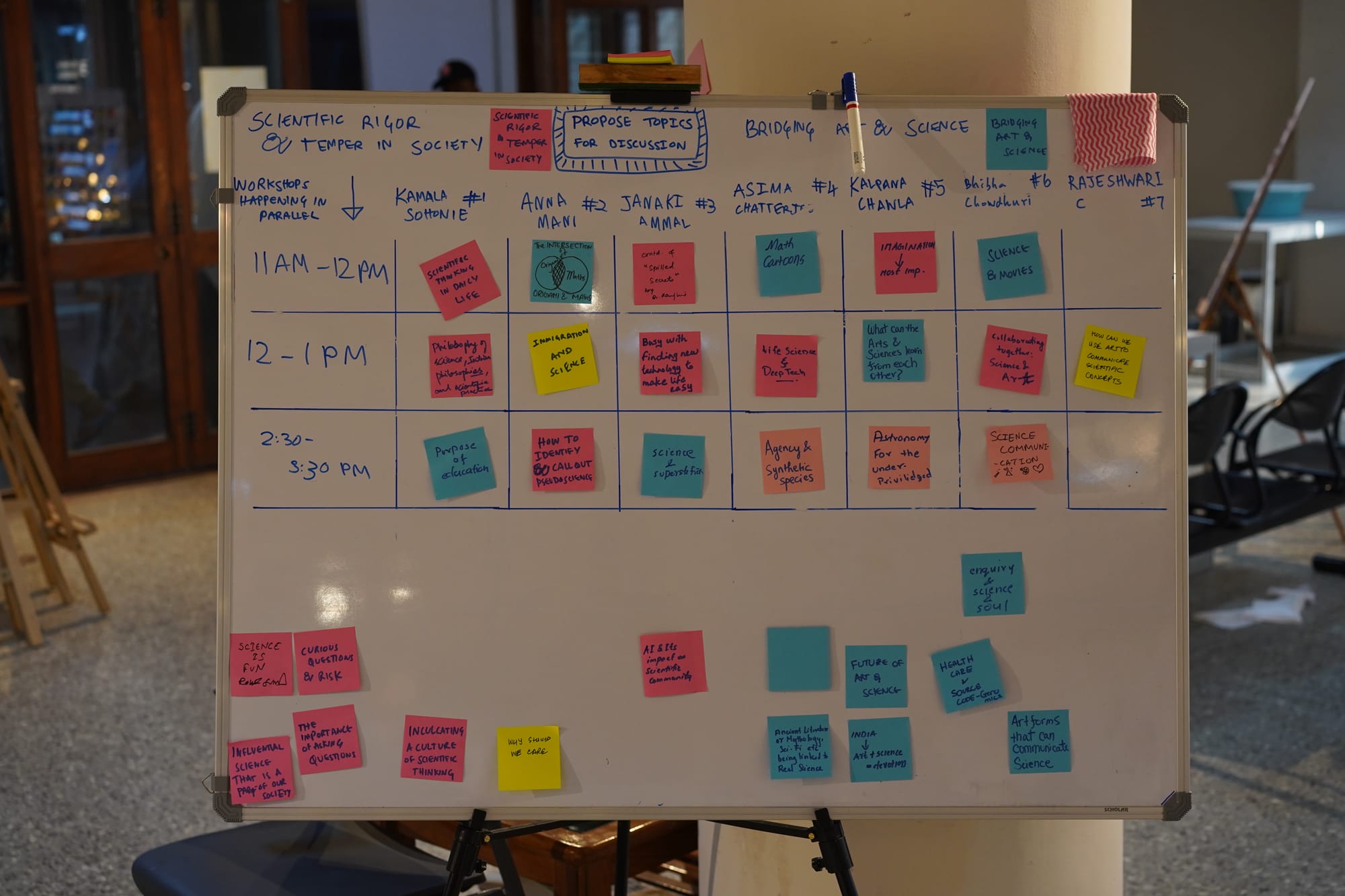
- Have a whiteboard and sticky notes (or equivalent) for participants to nominate “topics” for discussion in real-time as the event progresses.
- One or more facilitators hang around the whiteboard, helping people come up with topics for discussion
- Create one or more spaces that participants can use to discuss a specific topic, e.g., a group of chairs and a table
- Map topics to spaces, and guide the participants around the spaces and across time
- Tell participants to stick to the topic and to not veer off on tangents. No participant gets to dictate a discussion
- Ask the participants to share their opinions first, and only if requested, introduce themselves and substantiate their opinions
- Share summaries of discussions on at least a few topics with the entire event towards the end
Lessons from organizing Unconference events
The Science Sante event schedules (#1, #2) list hard-science lightning talks and Unconference sessions. We see a wave of confusion and excitement from the participants during the event when we tell them that they need to set the agenda for the unconference sessions. Broad themes of discussion are chosen for each event by the organizers, e.g., “Science Education”, “Science Communication”, and we add a few topics of discussion under these themes ahead of time to help the participants find some footing with the unconference event format. It doesn’t take long for the participants to nominate topics for discussion within those themes, e.g., Games for conservation, Astronomy for the underprivileged. We’ve had reasonable success running unconference events, so it’s worth understanding the format better and how we run events using the format.
What is an Unconference?
An Unconference is a participant-driven meeting, and unlike a traditional event where the event organizers set the agenda for the event ahead of time, the participants decide the agenda of an unconference during the event. This format is fairly common in software and technology industry gatherings. This is nerve-wracking, both for the event organizers and the participants, because the success of the event depends on whether the attendees actually participate in creating the event. So what does a Science Sante unconference look like?
Themes and Topics
For each Science Sante event, volunteers evaluate different “themes” for the unconference. These “themes” need to be broad and approachable, enabling the participants to interpret the “themes” according to their context and come up with “topics” for discussion. For instance, the “Science Education” theme was interpreted by an amateur astronomer as “Astronomy for the underprivileged”, and the “Science Communication” theme was interpreted by a conservation ecologist as “Games for conservation”. The events usually have one or two “themes”; anything more and we potentially risk disorienting the participants.
Before the event starts, the volunteers come up with a few “topics” ahead of time, with help from a few participants. In the past, we have asked participants to share “topics” that they would like to discuss with the other participants under the broad unconference themes. When the unconference starts, participants walk up to a whiteboard with sticky notes and propose “topics” for discussion. The “topics” that the volunteers come up with ahead of the event become illustrative examples for the participants. A few facilitators usually hang around the whiteboard to help people come up with topics under the themes. The more topics nominated by participants, the better the unconference.
Molding the space to spur discussions
The volunteers chop up the physical event space to hold parallel conversations. For Science Sante #1, we split the venue up into 6 spaces, and for Science Sante #2, we split the venue up into 8 spaces. The spaces aren’t, and don’t have to be, clearly physically demarcated. For instance, a group of chairs in the corner of a room works fine as a “space”. During the event, event volunteers map proposed topics to the available spaces. The unconference sessions lasted for 3 hours during Science Sante #2. We allocated 1-hour per topic, so with eight spaces, participants ended up discussing around 20 topics during the event.
Everyone has a voice
Suggesting topics for discussion is only the first hurdle that participants have to face in an unconference. The real hurdle comes when discussing a topic. Say you propose “Astronomy for the underprivileged” as a topic for discussion, it gets added to the agenda, and a few other participants get together to discuss this topic. You don’t get to “lead” the discussion of this topic as the proposer - other participants likely don’t know that you proposed the topic for discussion in the first place. As the proposer, at best, you get to steer and draw a boundary for the discussion, and this is surprisingly hard for most people to do. If you have domain expertise in the topic of discussion, you could steer the conversation with a few other participants in a certain direction, but the participants don’t have to choose this direction of discussion. You and the other participants can create and enforce an artificial boundary for the discussion, preventing the conversation from potentially veering off into tangents and ending up in no man's land. Both during Science Sante #1 and #2, we observed participants dictating the conversation for certain topics, and this goes against the spirit of the unconference - an unconference invites all the participants to share their thoughts and opinions, not just a privileged few. We also observed participants sitting together and waiting for a “speaker” for a given topic, and they are taken aback a little when we tell them that everyone in the group is a “speaker” and that no one special will come over to start the discussion. Participants also need to approach the discussion with some humility, that others' voices are just as important as theirs, even if other participants aren’t domain experts. And participants need to be comfortable being asked to shut up if they’re hogging the discussion.
The last hurdles people need to overcome are related to participant ego. In an ideal unconference, every single participant proposes one or more topics for discussion, but we don’t have the space or time to accommodate every single proposed topic of discussion. Your topic might not be chosen as part of the event agenda, and that might be a tough pill to swallow. Worse yet, your topic might be chosen as part of the event agenda, but no other participant chooses to engage in a discussion on your topic.
Your thoughts come first, and who you are comes next
And the most important rule of them all, your opinions and thoughts come before who you are and what you do. An hour isn’t a lot of time to meaningfully discuss any topic, let alone when there are 2 or more people participating in the discussion. Starting every discussion with a round of introductions from each participant takes away precious time that could be spent discussing the topic, especially for topics that attract numerous participants. Share your opinion with the group, and let the group ask you to substantiate your opinion, at which point you can go into who you are and why you cultivated the opinion. Most events have some form of networking time to allow participants to get to know one another, and if participants find your opinions interesting, they will inevitably seek you out after the discussion to get to know you better.
Missing out on conversations
An ideal unconference forces participants to evaluate opportunity costs and to confront their biases. What do you do when multiple topics are being discussed at the same time, and you find more than one to be interesting - do you participate in a topic that you know best or one you know least? An ideal unconference leaves participants happy and wanting at the same time - that they discussed interesting topics, but also missed out on other interesting discussions. Event organizers could share notes about each of the discussions with the participants, but this is a lot of work for a volunteer-led event.
What comes out of the discussions?
We talked about what gets discussed, but what comes out of the discussion? As participants nominate topics to discuss and self-select themselves to join certain discussions, it’s difficult to dictate certain outcomes from the discussions, but there are a few guidelines that the participants can follow to walk away with meaningful insights from a discussion. The participants could share their different perspectives on a topic, enabling everyone to have a better understanding of it. For example, for the topic “Is there discrimination in science?”, the participants could share different forms of discrimination, addressing any potential blind spots that participants might have on the topic. For the most part, we’re blind people feeling an elephant, so it helps us to communicate our understanding of a topic/problem. Maybe sharing mental models is the best course for certain topics, e.g., “Games for conservation”, to help participants reimagine and perceive topics in a different light. For certain topics, maybe the participants could go further by discussing specific interventions. For instance, for the topic “How to identify and call out pseudoscience”, the participants could codify common ways of peddling pseudoscience and collate resources that people could use to debunk them, like Phil Plait and his excellent work Bad Astronomy. Brownie points for the few groups that summarize their discussion to the event participants towards the end of the event. This doesn’t have to be polished; maybe the participants just read off personal notes from the discussion for a few minutes. If a PhD graduate can summarize her thesis work in 3 minutes, you can summarize your hour-long discussion in the same time.
Reimagining science together
An unconference requires a leap of faith from the event organizers and the participants. The event organizers hope attendees will actively participate, as the event can unravel quickly if participants do not propose discussion topics. Participants hope for an inclusive community that listens to their thoughts and opinions, and even a few bad apples that prevent participants from speaking up can sour the entire event. But it’s a sight to behold when everything comes together, and participants take the conversations to places that the organizers could have never planned or imagined.